Soybean Math 2025/26: Oil Makes Money, Meal Builds Pressure — ASAP Agri

Photo by: Latifundist.com
The soybean market is entering a new phase: the balance is no longer driven by meal — it is driven by oil. Crushing is expanding not because of feed demand, but due to strong biodiesel-driven demand, particularly in the U.S. As a result, soybean oil is now setting the margins and effectively “paying” for the crush.
More crushing, more imbalance
In this model, the imbalance emerges almost automatically. Every additional ton of soybeans processed generates not only more oil, but also more meal — regardless of whether the market needs it.
Global soybean crush has increased from around 276 MMT in 2015/16 to nearly 368 MMT in 2025/26, according to USDA estimates. Over the same period, soybean meal production rose from 216 to nearly 290 MMT, reaching a record high.
Consumption is also growing and approaching 290 MMT, but this is no longer enough to balance the system. Supply consistently outpaces demand, and the surplus accumulates in stocks — rising from around 14 MMT in 2022/23 to nearly 19 MMT in 2025/26.
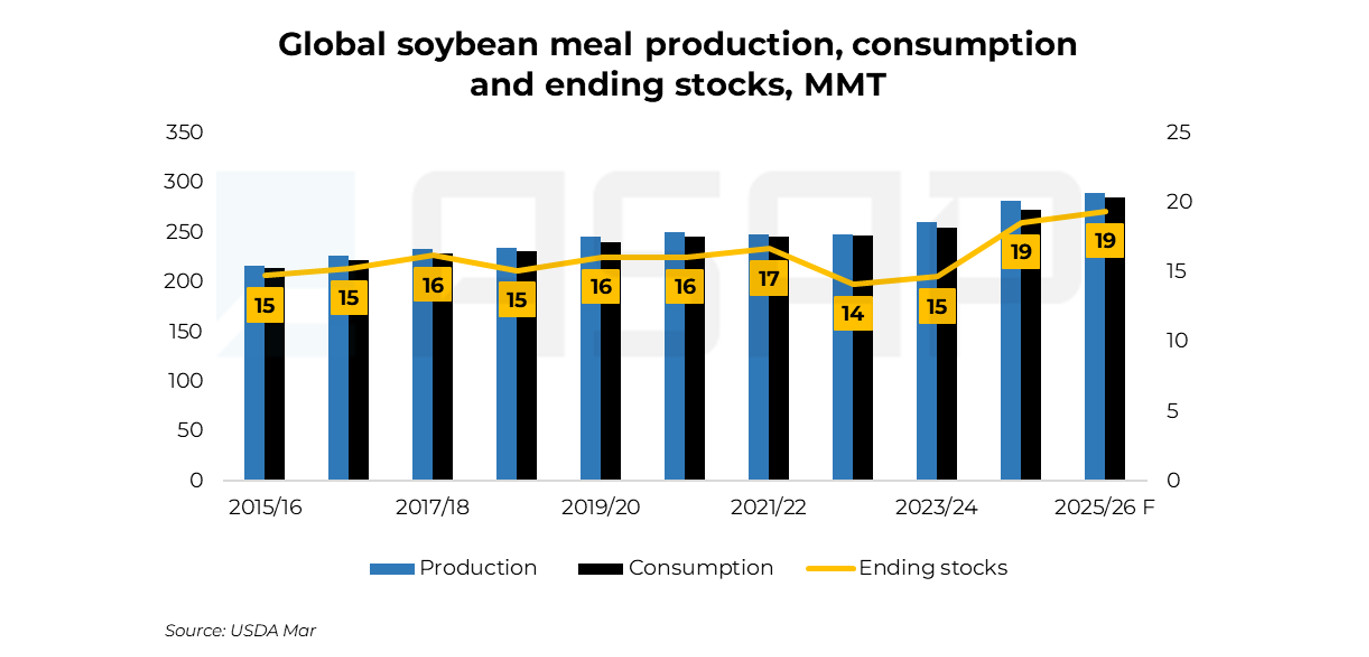
The market is effectively shifting from a balanced phase into a stock-building phase, with demand being the key constraint.
Demand: growing, but not fast enough
The feed sector continues to expand, but not fast enough to absorb the additional supply.
At the same time, downside risks to demand are increasing. The recent spike in energy prices, driven by escalating tensions in the Middle East, could have broader economic implications. If high oil prices persist, they are likely to weigh on economic growth and consumption, particularly in developing countries.
In such a scenario, growth in meat production may slow, directly limiting feed demand — and, in turn, soybean meal consumption.
Meanwhile, the supply side continues to expand. The market is already factoring in an expected increase in U.S. 2026/27 soybean acreage to 34.4–34.6 MHA, up from 32.9 MHA last season. Lower input costs compared to corn are making soybeans more attractive, implying more production, more crushing, and ultimately more meal entering the market.
The European factor will also contribute to the growing surplus in the soybean meal market. COCERAL — the leading European association of grain and oilseed traders — noted in its March outlook that EU farmers continue to cut corn acreage amid weak yields and high fertilizer costs.
Instead, they are increasingly switching to sunflower and soybeans, particularly in France and the Balkan countries. This shift is driving higher domestic soybean production in the EU and intensifying competition in the soybean meal market for importers.
Prices reflect imbalance
This structural surplus is clearly reflected in prices. On the CBOT, soybean meal (May’26 contract) is trading in the 310–330 USD/MT range, significantly below the levels seen in 2022–2023.
After a prolonged downtrend, the market is attempting to stabilize but remains below key long-term averages. The recent upside move appears to be a technical rebound rather than the start of a sustained bullish trend.
Short-term strength in Chicago has also been mirrored in the physical market. Argentinian soybean meal prices have firmed in recent weeks, but this move was largely driven by external factors — primarily higher crude oil and freight costs — rather than by a shift in underlying fundamentals.
As a result, a clear asymmetry is emerging: soybean oil is supported, while soybean meal remains under pressure from excess supply.
For crushers, this means a structural shift in margin dynamics — increasingly driven by oil rather than meal. For the market, it implies persistent price pressure.
Unless a new demand driver emerges or crushing slows, soybean meal will remain the weakest link in the oilseed complex.
What this means for Ukraine
For Ukraine, this global model has direct implications.
In the 2025/26 season, the country is following the same trend but driven by different factors. At the start of the season, soybean processing surged, supported by the introduction of a 10% export duty on soybeans for intermediaries and a smaller sunflower crop. Between September and December, soybean meal production reached 220–285 KMT per month, significantly above previous seasons.
Even accounting for a seasonal slowdown later in the year, Ukraine is on track to achieve one of its highest crushing levels in recent seasons.
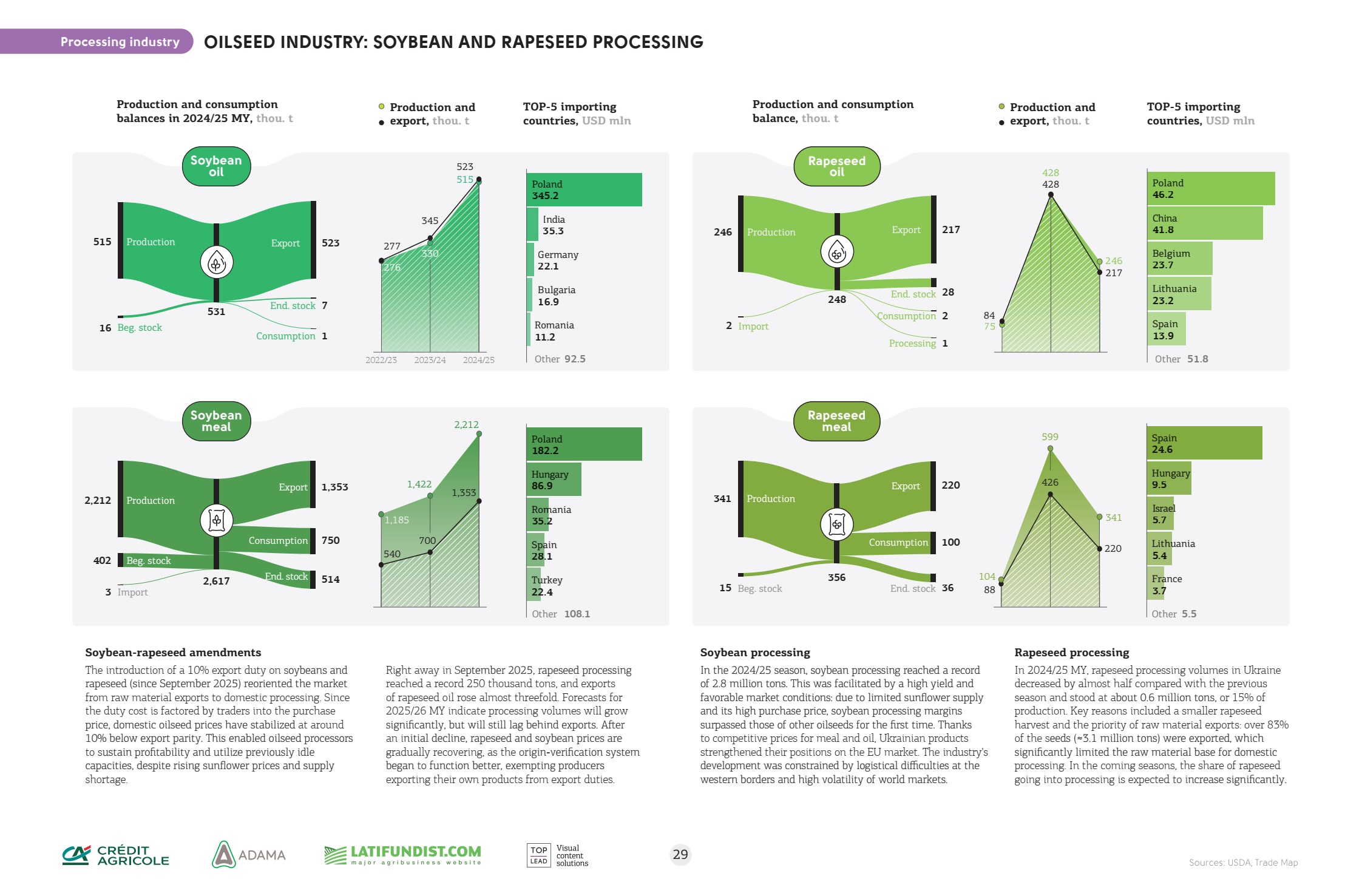
As a result, exports are also increasing. Between September and February 2025/26, soybean meal exports reached approximately 784 KMT, compared to 566 KMT a year earlier and 352 KMT in 2023/24.
Exports are highly concentrated geographically: 47% went to Poland (295 KMT), 24% to Hungary (147 KMT), 12% to Turkey (76 KMT), and 11% to Romania (70 KMT). Overall, around 74% of shipments were directed to the EU, highlighting strong dependence on EU demand.
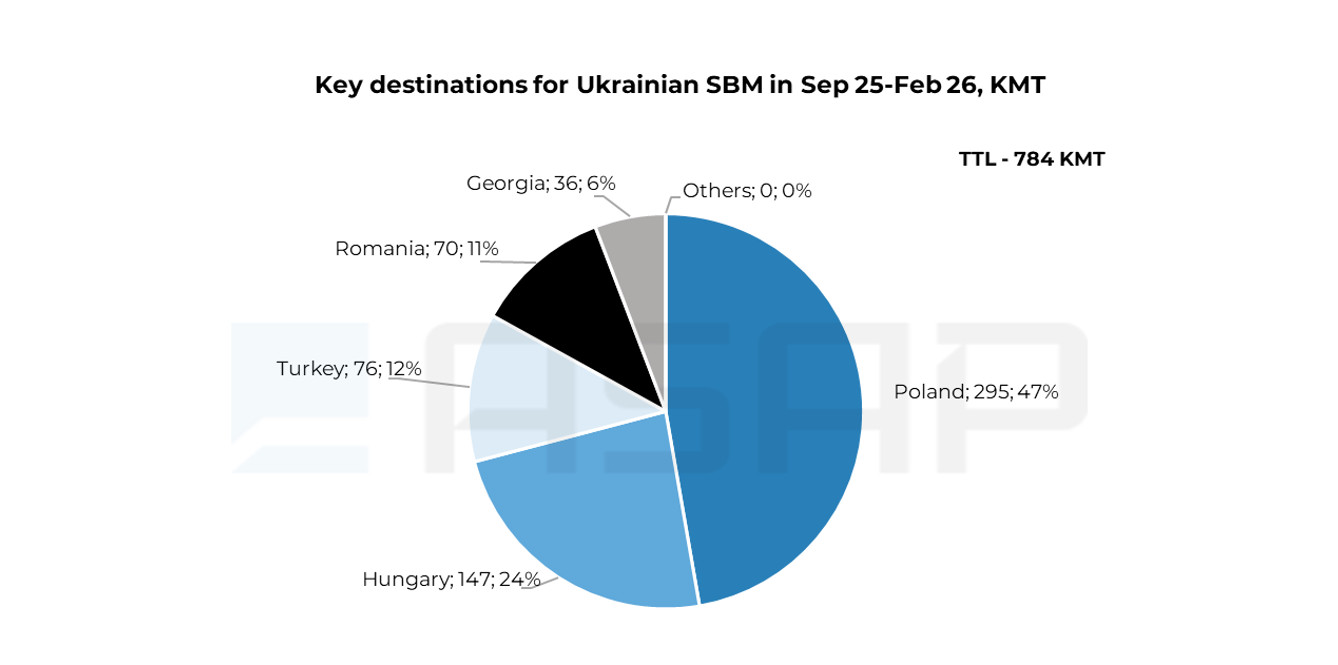
Volume growth is coming with a higher concentration. Ukraine is strengthening its position in key markets while increasing its exposure to demand shifts in those destinations.
In a structurally oversupplied market, the risk is not volume — it is price and competition. More meal means tougher competition, particularly against other exporters.
With exports heavily concentrated in the EU and Turkey, even small demand changes can quickly translate into pricing pressure.
For now, rising crush supports exports. However, amid structural changes in the global market, the key question is not only how much soybean meal Ukraine can sell, but also at what price.