Over 600,000 hectares of top-100 agrocompanies under occupation — three most affected companies named in Latifundist and Forbes study


As a result of Russia’s full-scale war against Ukraine, more than 600,000 hectares of land owned by companies ranked in the TOP-100 largest agricultural companies are currently under occupation, according to a joint study by Latifundist and Forbes Ukraine. The findings were presented at the Forbes Agro 2026 conference held in Kyiv on February 26.
In total, the combined land bank of the TOP-100 companies amounts to approximately 5.3 million hectares — nearly a quarter of Ukraine’s total sowing area, estimated at 23 million hectares. The companies that have suffered the greatest losses due to occupation are Ukrlandfarming, Agroton and HarvEast.
In particular, Agroton lost its entire land bank due to the occupation of its assets in eastern Ukraine. At the same time, the company has already begun rebuilding its position: last year it acquired one of Agroprosperis’ assets in Kharkiv region and, according to the study, plans further expansion.
The study focused primarily on the 30 largest agricultural companies, which together cultivate 3.77 million hectares. The largest land bank belongs to Kernel, with 358,000 hectares, while companies at the bottom of the TOP-30 manage around 50,000 hectares each.
The war has significantly reshaped the land market structure. Companies that lost assets in occupied territories are actively seeking new land in government-controlled areas. Demand has shifted mainly to the right bank of the Dnipro River and western regions of Ukraine due to security considerations and more favourable climate conditions.
This has led to a sharp increase in prices. According to market participants, the cost of leasing or purchasing land on the right bank can reach up to $3,000 per hectare, with demand exceeding supply.
At the same time, some investors are acquiring land assets in frontline areas at significant discounts — between $300 and $500 per hectare — betting on a recovery in value after the war ends.
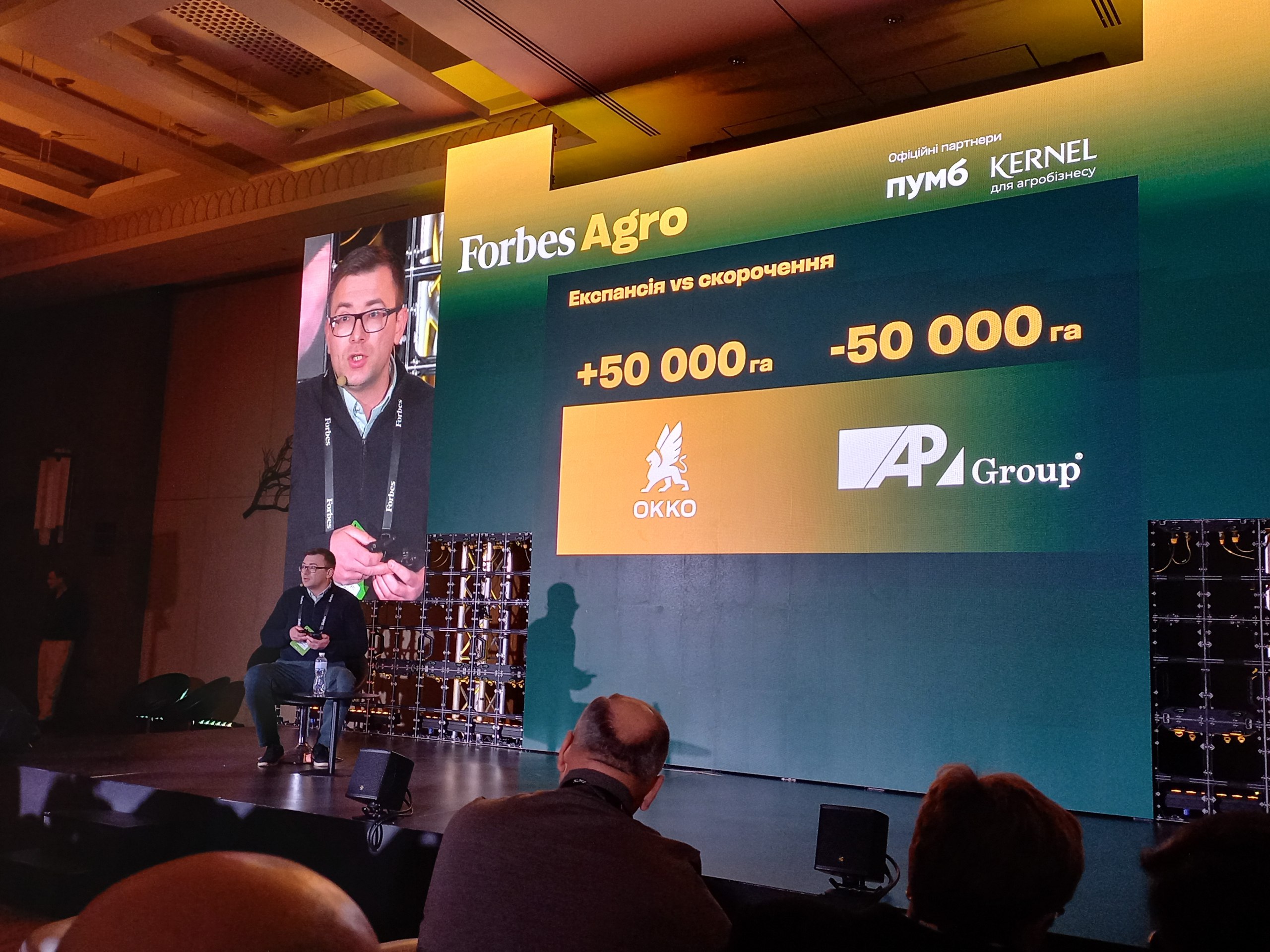
The study also highlights a shift in the balance of power among agribusinesses. In particular, OKKO GROUP has expanded its land bank from zero to approximately 50,000 hectares in just a few years.
“However, there are also players whose land banks have decreased. I would include Agroprosperis among them, as it has slimmed down by roughly 50,000 hectares over the past four to five years. Last year, they were selling assets in frontline areas, which follows a certain pattern. Although recent sales have also been recorded in central Ukraine. According to our data, this is not a sign of the company exiting Ukraine,” said Kostyantyn Tkachenko, Editor-in-Chief of Latifundist.com, during the presentation.
“There are two largest agribusiness companies in Ukraine — both in terms of land bank and revenue — which together account for nearly half of the entire TOP-30. Starting from around the TOP-10, the density of the ranking decreases significantly: the next seven companies are substantially smaller in scale compared to the leaders. Meanwhile, the last 20 companies combined roughly equal half of the first ten’s indicators,” noted Oleksiy Blinov, Head of Analytics and Research at Forbes Ukraine.