Back to the Sea. How NIBULON is Preparing Mykolaiv for Grain Exports



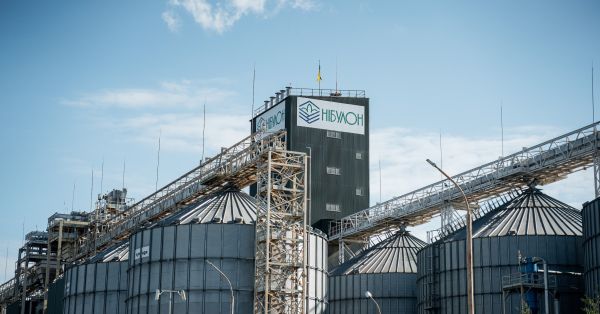
Photo by: NIBULON
Mykolaiv’s port terminals could restart operations at any moment. But a major barrier still stands between readiness and real export — mined waters, unsafe navigation routes, and blocked channels. NIBULON, which developed its own humanitarian land demining operations after the full-scale invasion, is now working with international partners to transfer this expertise to water. Latifundist.com looks at how this could work.
From Seaport to “Dry Port”
Before the war, the EVT terminal in Mykolaiv’s Olvia port handled over 3 million tonnes of grain annually. For the fourth consecutive year, it has not performed its core function — maritime exports, says Dmytro Manoliuk, EVT Commercial Director. Instead, the terminal effectively operates as a “dry port.”
“We are ready to resume maritime shipments at any moment once permission is granted. I believe other terminals will restart just as quickly. However, part of the workforce has left over these years, which is another challenge.”

EVT is not an exception, but rather a reflection of Mykolaiv’s terminals as a whole. Restarting maritime exports is equally important for NIBULON, which operates a terminal with a capacity of 170,000 tonnes per year, says Oleksandr Dolzhenkov, Director of Government Relations at NIBULON. He recalls that in 2021, more than 30 million tonnes of agricultural products were shipped through Mykolaiv — the highest volume among all Ukrainian ports.

NIBULON currently exports via the ports of Greater Odesa and the Danube. This changes the economics of exports: today, logistics from central Ukraine to Spain cost around $50 per tonne via Greater Odesa ports and $65 per tonne via the Danube.
“Reopening Mykolaiv port would bring costs down to about $45 per tonne. That would boost farmgate prices and strengthen export economics, particularly in frontline regions that need it most.”

Even where individual operators have already surveyed their own water areas, this is not enough to restore navigation. The issue is not with individual berths, but with access to the entire Mykolaiv port. The critical chokepoint is the Dnieper-Bug estuary, and without safe passage through it, Mykolaiv cannot return to full maritime logistics.
Who will build the infrastructure for a task that, in reality, does not yet exist in Ukraine?
Ukraine remains the most heavily mined country in the world. Some 13,500 sq. km of waters across the Black Sea, the Sea of Azov, and inland waterways are contaminated. Around 400 mines are officially recorded in the Black Sea, but the risks go far beyond that — including cluster munitions, missile debris, and sunken military vessels carrying explosive threats. The most dangerous areas lie around Greater Odesa and between Odesa region and Crimea.
A Focus on Long-Term Capacity
NIBULON has taken on part of the mission. In December, together with DEG Impulse, a subsidiary of the German development finance institution DEG, the company began preparing a joint water demining project.
The initiative involves building a technical base for water operations, training 60 specialists, developing service infrastructure, and creating an operational model that will remain viable after the war.
The initial land demining project has been expanded to €15.6 million under the develoPPP program. Half of the funding is provided by DEG Impulse, while the remaining 50% is invested by NIBULON itself. The program is financed by Germany’s Federal Ministry for Economic Cooperation and Development (BMZ).

The collaboration between DEG Impulse, BMZ, and NIBULON started two years ago with the establishment of a land demining unit and the acquisition of four GCS 200 land demining machines.
According to Daniel Alex, DEG Impulse`s Senior Investment Manager, such investments are designed to back long-term projects rather than one-off initiatives, ensuring that they will continue beyond the project duration.

Daniel Alex
DEG Impulse`s Senior Investment Manager
“The develoPPP program aims to match sustainable impact with commercial interests of our partner companies. This way we create sustainable, long-term projects that continue beyond the initial support phase which is only possible when the partner company also benefits in some way.”
Is the government planning to demine water areas?
The government is at an early stage in addressing maritime demining. A full survey of water areas will only be possible after the active phase of the war ends, Dmytro Panshyn, Head of the Humanitarian Demining Department of the Ministry of Economy of Ukraine. Planning is expected to begin no sooner than three months after that.

Dmytro Panshyn
Head of the Humanitarian Demining Department of the Ministry of Economy
“That is only logical. The Dnipro River is mined and cannot be considered navigable, as it partially runs along the frontline. At sea, the challenge differs. The presence of naval drones renders demining operations effectively impossible during active hostilities. Consequently, the cessation of hostilities will serve as the starting point for planned demining.”
While the war continues, the government is laying the groundwork: regulations, standards, and teams of operators. Some work is already underway. If mines or other explosive objects are found in the water, State Emergency Service specialists are dispatched to the site to neutralise them. There is still no infrastructure for underwater demining in Ukraine, but 13 certified teams have already been trained, half of which are units of the Security and Defence Forces, specifically the Ukrainian Navy.
The problem isn’t just the complexity of the work, explains Oleksandr Dolzhenkov. It’s also an economic issue. While a cleared field can be quickly returned to cultivation and yield a financial return, water areas do not offer immediate payback for operators. Instead, everyone benefits from the results — shipping companies, port operators, farmers, and the state. That is precisely why such projects rarely get off the ground without international partners.
From Land to Water
The holding’s experience in land demining will help clear the sea of mines. Since 2023, NIBULON has been developing this capability, returning farmland in southern Ukraine to cultivation. To date, the company has restored more than 7,000 hectares of agricultural land. This has enabled 560 landowners to either farm their plots or receive rental income.
Demining waterways further develops the initial land demining project, agrees Daniel Alex, DEG Impulse.
Daniel Alex
DEG Impulse`s Senior Investment Manager
“Many farmers in the region can grow grain but cannot sell it: exports are either physically impossible or too expensive. NIBULON is willing to address this challenge. This effort is an important contribution to enhancing local stability and operational security, particularly under current conditions.”
Read also: We clear mines and sow immediately. How NIBULON’s demining department works
Currently, the demining department provides commercial services and fulfils government contracts, operating in various regions of Ukraine. For example, in March, work began on clearing agricultural land in the Kharkiv region with a total area of 103 hectares. The land to be cleared is located in an area that was previously the “zero line,” the front line of combat.
Because of this, mine action operators call this area the most challenging one currently in existence.
“We’ve begun work in one of the most challenging demining areas — Kharkiv region — and will soon return to the south to carry out preparatory work for water demining, including clearing access routes to the Southern Bug River,” says Vsevolod Petrovskyi, Head of Demining Department at NIBULON.

Why Even Cleared Waters Do Not Mean a Safe Sea
Underwater demining is an entire system, not a one-time operation, emphasises Vsevolod Petrovskyi. It involves not only searching for mines or removing dangerous objects, but also training divers and deminers, maintaining the fleet, monitoring waterways, and coordinating with government agencies. Without this, even after the war ends, the resumption of navigation could be delayed for years.

Even after a ceasefire and the resumption of navigation, the Russians will still be able to continue laying mines along trade routes, suggests Manoliuk from EVT. Particularly dangerous areas include the waters of the ports of Greater Odessa, Pivdennyi Port, and Port of Chornomorsk, where navigation passes through narrow channels.
Mines could be secretly “scattered” by merchant ships or unmanned boats, forcing deminers to re-survey and clear the waters. “Migrating” mines, which currents could carry from uncleared areas to safe ones, could also become a problem.
However, even if waterways are mined again on a limited scale, it won’t stop ships or exports, suggests EVT’s Commercial Director. Currently, grain convoys are escorted by minesweepers, and such vessels will continue to accompany ships for a long time after a ceasefire. He cites Turkey as an example: mines are still being detected near its shores, yet life and economic activity continue in the country.
“Even if mines are found from time to time, shipping continues to operate. The key is to have a proper response system,” agrees Oleksandr Dolzhenkov.
Such a system will depend on cooperation with the Ministry of Defence, which is responsible for maritime mine clearance, and the State Emergency Service, which operates on rivers and lakes, he adds.
In other words, the goal is not to clear the waterways once and for all. The task is to build a system that will allow the export sector to continue operating even if the risk does not disappear.
Therefore, the stakes here are higher than just one infrastructure project. The goal is to begin preparing for recovery even before a formal ceasefire is in place.
“DEG Impulse’s support allows us to begin building capacity even before the active phase of war ends, thereby reducing the time between the ‘arrival of peace’ and the actual economic recovery.”
Kostiantyn Tkachenko, Sofia Yaroshenko, Oleksii Kozachenko, Latifundist.com